
“HOW TO CHOOSE A GOOD PASTOR”
Making a Mountain Out of a Myth
Jon Zens
Assumptions are the devil’s details. All of us make pretty far-reaching decisions based on assumptions. If our assumptions turn out to be mistaken, the results can be devastating. For example, years ago when asbestos was used on a large scale, it was considered to be a helpful and valuable product. Of course, at the outset there was no history of its effects on humans. It came to be assumed that it was generally safe. But years later it became obvious that thinking it was safe was a mistake of monumental proportions. It took years of human exposure to asbestos to reveal that the assumption of its safety was fatal.
A Deep-Seated Assumption: You Need A Pastor
A fatal assumption has existed for hundreds and hundreds of years in Christianity. It is this: every group of believers needs a human pastor. I say human pastor because in Hebrews Jesus is called our “mega-pastor,” the Great Shepherd of His sheep. So believers indeed have a “pastor,” and He is Jesus Christ.
But when you think about it there is absolutely nothing in the New Testament about “the pastor” being the linchpin of all that goes on in a local gathering of believers. Yet reflect on how many books, articles and sermons there have been since the 1500’s about all the aspects of “the pastor.” One dimension that has generated a lot of space over the years is “How to Choose a Good Pastor.” Recently, Ralph Drollinger of Capitol Ministries published an article with this title (November 21, 2016, www.capmin.org). I’d like to take a look at what he says since he perpetuates many baseless assumptions that are worth a second look.
Of course, the idea of choosing a pastor assumes that such a position should exist, and that believers should occasionally have to concern themselves with such a choice. Neither of these assumptions can be discovered in the New Testament. Thus, the author is building part of an infrastructure about “the pastor” on a non-existent foundation. Thus, in the end, his article expresses convictions arrived at by imposing traditional components of church on the NT.
Be Careful Who You Hire
As might be expected, Ralph couches choosing a good pastor in business world terminology. “You are,” he says, “very careful, deliberate and wise about who you hire in your office. The procedures you follow relative to employment help assure that you get what you are looking for . . . . Properly rating another (like you do those seeking employment in your office) relates to good judgment.” Again, however, where does the NT reveal a duty believers have to hire one paid person to fill the position of pastor? The ekklesia (assembly) is a family not a business that fills office spaces.
“Pastoral Epistles”?
The answer to what makes a good pastor, he suggests, “is gained by studying what are known as the Pastoral Epistles.” It must be underscored, however, that this designation of three letters reflects church traditions, not NT reality. It is crucial to note that the tradition of designating 1 & 2 Timothy and Titus as “Pastoral” Epistles is very misleading. David P. Kuske calls Timothy a “young pastor.” This reveals a mistaken assumption because clearly Timothy and Titus were not resident elders. They were itinerant apostolic assistants. Paul “left” them in various places to help the assemblies. Paul at one point told Timothy to “do the work of an evangelist” (2 Tim.4:5). In these three letters Paul gave his co-workers instructions regarding issues and problems faced by the assemblies they moved among and assisted. As Frank Viola rightly observes:
Labeling 1 Timothy, 2 Timothy and Titus the ‘Pastoral Epistles’ or the ‘Pastorals’
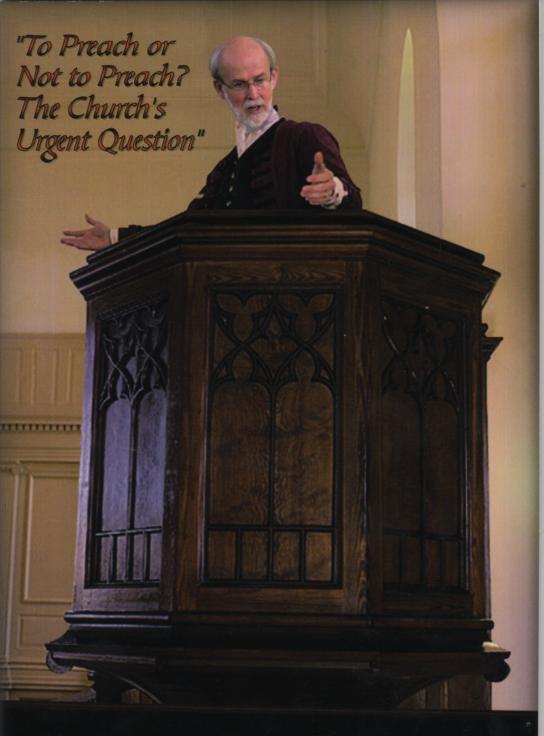
Searching Together 36:1-2 2009 “To Preach or Not to Preach?”
is a misnomer. These letters were not given this label until the 18th century. Timothy and Titus were not pastors. They were apostolic workers (Untold Story of the NT, p.160).
Where Is the Pastor to Be Found?
Ralph believes that “by far the largest amount of passages related to the pastor have to do with his injunction to teach and preach the Word of God.” But the truth in Christ is that there are no passages in the NT that deal with “the pastor.” The traditional practice of each church having a salaried pastor who stands behind a pulpit and gives sermons, visits the sick, counsels parishioners, administers church business, and whose “vision” directs the church is unknown in the NT. Massive confusion and misinformation is created when the traditional view of “the pastor” is assumed when the NT is read or cited.
One Pastor?
The author maintains that the NT teaches each local church needs one pastor. He says, “The Pastor-Teacher is best understood as one person in Eph. 4:11.” He then cites verse 11 in part like this: “. . . and some as pastor and teachers.” But in the Greek text it is not singular, pastor, but plural, pastors — “pastors-teachers.” The concept of shepherding in the NT is always plural, as in James 5, “if any of you are sick let them call for the elders of the church.”
The Body Is Christ On Earth
Ralph sees the one person who is the pastor as “the kind of leadership that Jesus Christ has given and intends for the Body of Christ in His physical absence (in-between His first and second incarnation) . . . . to lead His body in-between the First and Second Coming of Christ.”
But this line of thought omits some significant aspects of the Lord’s purpose in Christ. In John 14 Jesus promised that His physical departure would not result in them being left as orphans. Why? Because He would come in the person of the Spirit to lead them and reveal Himself to them. Jesus assured the disciples with the words, I will come to you. He fulfilled these words when He sent the Holy Spirit on the Day of Pentecost. This Pentecostal coming of the Spirit to the ekklesia must also be seen as a coming of Christ.
Thus, the ministry of Christ is continued on earth — not through the pastor of each local church — but through His Body, the ekklesia (see Youtube, Jon Zens, The Tucson Videos 2016, #13, “Jesus Continues on Earth Through Us”). This is why the NT letters are addressed to the saints, not to the pastor. In Matthew 18:17 the final setting of decision-making was “bring it to the ekklesia.” No leaders were mentioned.
In 1 Cor. 5 immorality was dealt with when the believers came together and dealt with the unrepentant person. There was no mention of “leaders.”
In 1 Cor. 6, disputes among the saints were to be resolved by those in the body, not taken to unbelieving judges. Initiative from “leaders” was not in the picture.
A gathering of the Body is described in 1 Cor. 14. Everyone participated — “each one of you has a song, etc.” — and there was no pastor, no pulpit and no sermon. In fact, there was no distinction between those “up-front” and those in an audience. When you boil everything down, R.C. Sproul rightly concluded that “in Protestant worship, for the most part, we sit and listen to a sermon.” Yet there is nothing in the NT about a pastor giving a weekly sermon. There is no one “leading” the gathering in 1 Cor. 14 — except Christ by the Spirit.
One Person or One Another?
The inordinate focus on “the pastor” provides a huge clue as to why the Body of Christ is so unhealthy. When you build everything around that which is nowhere revealed in the NT, you will then not practice that for which there is abundant revelation — the 58 one anothers. “Love one another, encourage one another, pray for one another, honor one another, greet one another, etc., etc.” Just like what happened with the Pharisees, because their passion was directed toward the wrong things, the right things were left undone (Matt. 23:23-24).
Why Do We Have to Choose a Pastor?
So Ralph encourages believers to put yourself “in association with a pastor who will stimulate spiritual growth . . . . Ask judiciously, ‘Does the pastor I’m following really shepherd me? . . . Choose wisely your pastor!”
But where does the NT narrative suggest that any believers should concern themselves with such a choice? It seems to me that to put energy into such a topic as “How to Choose a Good Pastor” is akin to devoting space to “How to Choose a Good Myth.” How can you choose an entity that does not exist? Of course, you can be involved in choosing a pastor in a traditional church, but just keep in mind that the notion of this “office” is a human construct, not the Lord’s mind.
What Mark Lake said recently on Facebook nails it:
“I have come to see all believers as leaders. All can hear God through the Holy Spirit give direction to the body. Leadership can appear in so many different ways. I focus less on ‘leadership’ and more on following Christ through the Spirit. If a group of believers are doing this together, Christ will lead through the whole body, using different people at different times or in different seasons. If we focus more on one-anothering, then the ‘leadership’ will be available when needed.”
— Jon Zens, December, 2016
For further reflection:
George Barna/Frank Viola, “The Pastor: Obstacle to Every-Member Functioning,” Pagan Christianity, pages 105-143.
Emil Brunner, The Misunderstanding of the Church, 1952, 132 pages.
David H.J. Gay, The Pastor: Does He Exist? 2014.
Anthony Jacomb-Hood, Rediscovering the New Testament Church, 2014, 305 pages.
Malachi O’Doherty, Empty Pulpits: Ireland’s Retreat from Religion, 2008, 254 pages.
Clyde Reid, The Empty Pulpit, Abingdon, 1967.
Clyde Reid, The God-Evaders, Abingdon, 1966.
Milt Rodriguez, The Community Life of God.
Jon Zens, 58 to 0 — How Christ Leads Through the One Anothers.
 Author, speaker, editor of Searching Together, itinerant encourager of relational communities.
Recent Comments